Bank of England raises rates to 4%:
will the pound gain momentum?
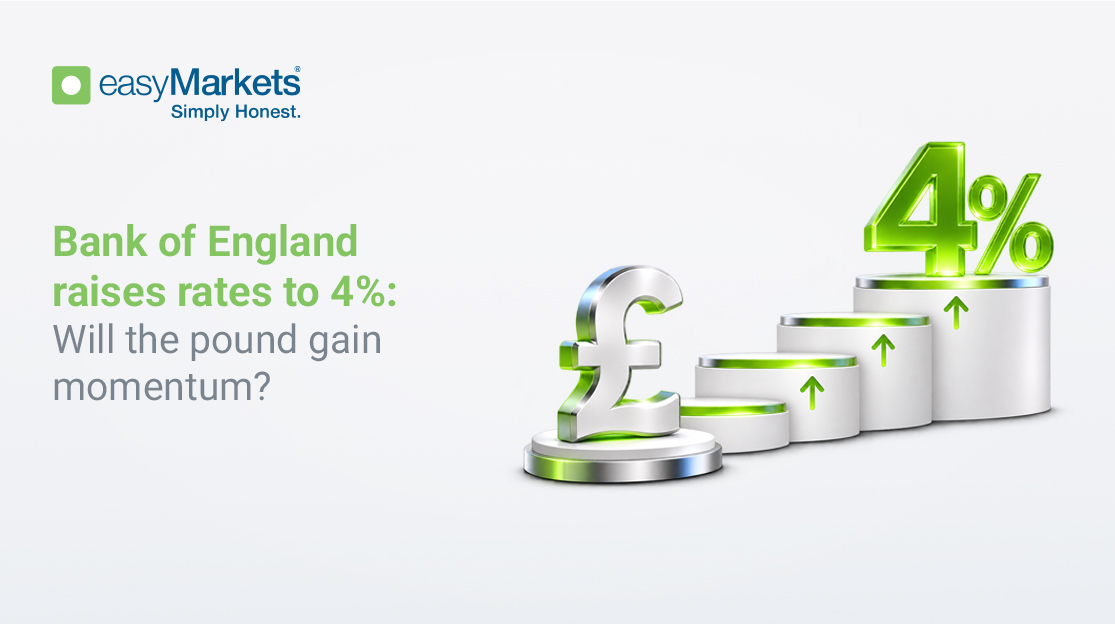
The Bank of England (BoE) has raised interest rates by 0.25 percentage points to 4%. The Monetary Policy Committee (MPC) voted 8–1, with one member wanting a bigger increase. For traders, the decision puts the British pound firmly back in the spotlight.
UK inflation rose to 3.5% in September, well above the Bank's 2% target, and policymakers expect it to climb towards 5% by mid-2027. But a rate hike on its own does not guarantee a stronger currency. What happens next will depend on how this decision compares with market expectations, and with what the US Federal Reserve (Fed) and European Central Bank (ECB) do next.
Here is what traders should know, and what to watch in the weeks ahead.
1. Why did the Bank of England raise interest rates?
The main reason is inflation, and energy is a big part of the story. UK consumer price index (CPI) inflation, which tracks the prices of everyday goods and services, rose to 3.5% in September, with energy accounting for roughly one percentage point of that. The conflict in the Middle East has pushed oil and gas prices well above the levels the Bank assumed in the summer, pushing up household bills and transport costs.
The bigger worry is what economists call second-round effects: higher prices lead workers to ask for bigger pay rises, and businesses then raise prices again to cover those costs. The Bank says this has not happened yet, but with wage growth around 3.5% and inflation above target for about five years, the risk has risen.
Catherine Mann voted for a larger half-point rise, while Alan Taylor called the move a precautionary "one-for-now" hike. In short, the Bank is trying to get ahead of a problem rather than react to one.
2. What does the rate hike mean for GBP?
In theory, higher rates make a currency more attractive by offering investors a better return. In practice, markets look ahead. If a hike is already priced in, it may cause little movement, and the pound could even weaken if investors hoped for a stronger signal.
That is why expectations matter. The Bank's own survey shows markets expect Bank Rate to reach 4.25% by February, with some pricing suggesting more. If the BoE delivers less than anticipated, the pound could lose support. If inflation data push policymakers to act more aggressively, sterling could gain momentum.
For GBP/USD, the BoE is only half the picture. If the Bank keeps tightening while the Fed holds steady or moves towards easing, the gap in interest rates could favour the pound. If strong US data keep Fed rates higher for longer, the dollar could limit sterling's gains. And if the energy shock weighs on UK growth, slowdown worries could cap the pound's upside.
EUR/GBP offers a direct read on the UK against the eurozone. If the BoE looks more willing to raise rates than the ECB, the pound could strengthen and push the pair lower. A more hawkish ECB, meaning one more focused on fighting inflation, or weaker UK growth could move it the other way.
3. How could UK stocks and the economy react?
Higher rates raise borrowing costs across the economy. Benchmark two-year mortgage rates have already risen by nearly half a percentage point since early September, so homeowners coming off fixed deals may face higher payments. With energy bills rising too, consumers may cut back, hitting retailers and hospitality. The Bank itself expects growth to slow somewhat.
Many FTSE 100 companies earn much of their revenue overseas, so a stronger pound makes those earnings worth less in sterling terms and can weigh on the index, while a weaker pound tends to help.
Sectors matter too. Banks can benefit from higher rates and energy companies may gain from higher oil and gas prices, while housebuilders, retailers and heavily indebted firms could struggle. More domestically focused stocks, such as those in the FTSE 250, may feel a consumer slowdown more directly.
4. What's next for the Bank of England?
The Bank says decisions will be made meeting by meeting, and the next announcement is due on 17 December. The MPC is divided: Clare Lombardelli and Huw Pill see a likely case for another increase, Governor Andrew Bailey would consider one but then take a more conditional approach, and Alan Taylor suggested the next move could be up, down or sideways.
That leaves the data in charge. The Bank's staff project CPI at around 4.5% in early 2027 and 5% by mid-2027. Readings above those projections could build pressure for another hike, while softer figures could strengthen the case for waiting. Wages, energy prices and growth will also shape the outlook, and a sharp slowdown could make policymakers more cautious.
5. What should traders watch?
For GBP/USD, watch US jobs and inflation figures and Fed comments as closely as UK data. EUR/GBP may react just as much to ECB announcements and eurozone inflation as to BoE news.
Monthly UK CPI releases will be among the most important events. Look beyond the headline number to core inflation, which excludes food and energy, and services inflation, which shows whether price pressures are spreading. The surprise against forecasts often matters more than the number itself.
At the 17 December meeting, watch the vote split and the minutes. More votes for a hike could be read as hawkish, while more votes to hold or softer wording could be read as dovish, meaning less inclined to raise rates.
How traders can prepare
It helps to think through scenarios before major releases. What could happen to GBP/USD if UK inflation runs hotter than expected? How might the pound react if the BoE sounds more cautious in December? A plan makes it easier to stay disciplined.
Risk management deserves just as much attention. Central bank decisions can trigger sharp swings, and leverage can magnify losses as well as gains. Be aware of slippage and price gaps, avoid risk beyond your means, and remember there is no need to trade every headline.
Conclusion: the pound's next move depends on what comes next
The BoE's move to 4% shows how seriously it is taking the risk of persistent inflation. The hike offers the pound potential support, but how far it goes will depend on how the BoE's path compares with the Fed's and the ECB's. With the MPC divided, expectations could shift quickly. For traders, the goal is not to predict every move, but to understand what could drive the pound, follow the data that matter and manage risk carefully.
This Article is for informational and educational purposes only and does not constitute investment advice. It does not consider the financial situation, needs, or objectives of any specific individual. Any reference to past performance is not a reliable indicator of future results.
Risk Warning: 68% of retail investor accounts lose money when trading CFDs with this provider. You should consider whether you can afford to take the high risk of losing your money. Please refer to our full risk disclaimer on our website.
The Bank of England (BoE) has raised interest rates by 0.25 percentage points to 4%. The Monetary Policy Committee (MPC) voted 8–1, with one member wanting a bigger increase. For traders, the decision puts the British pound firmly back in the spotlight.
UK inflation rose to 3.5% in September, well above the Bank's 2% target, and policymakers expect it to climb towards 5% by mid-2027. But a rate hike on its own does not guarantee a stronger currency. What happens next will depend on how this decision compares with market expectations, and with what the US Federal Reserve (Fed) and European Central Bank (ECB) do next.
Here is what traders should know, and what to watch in the weeks ahead.